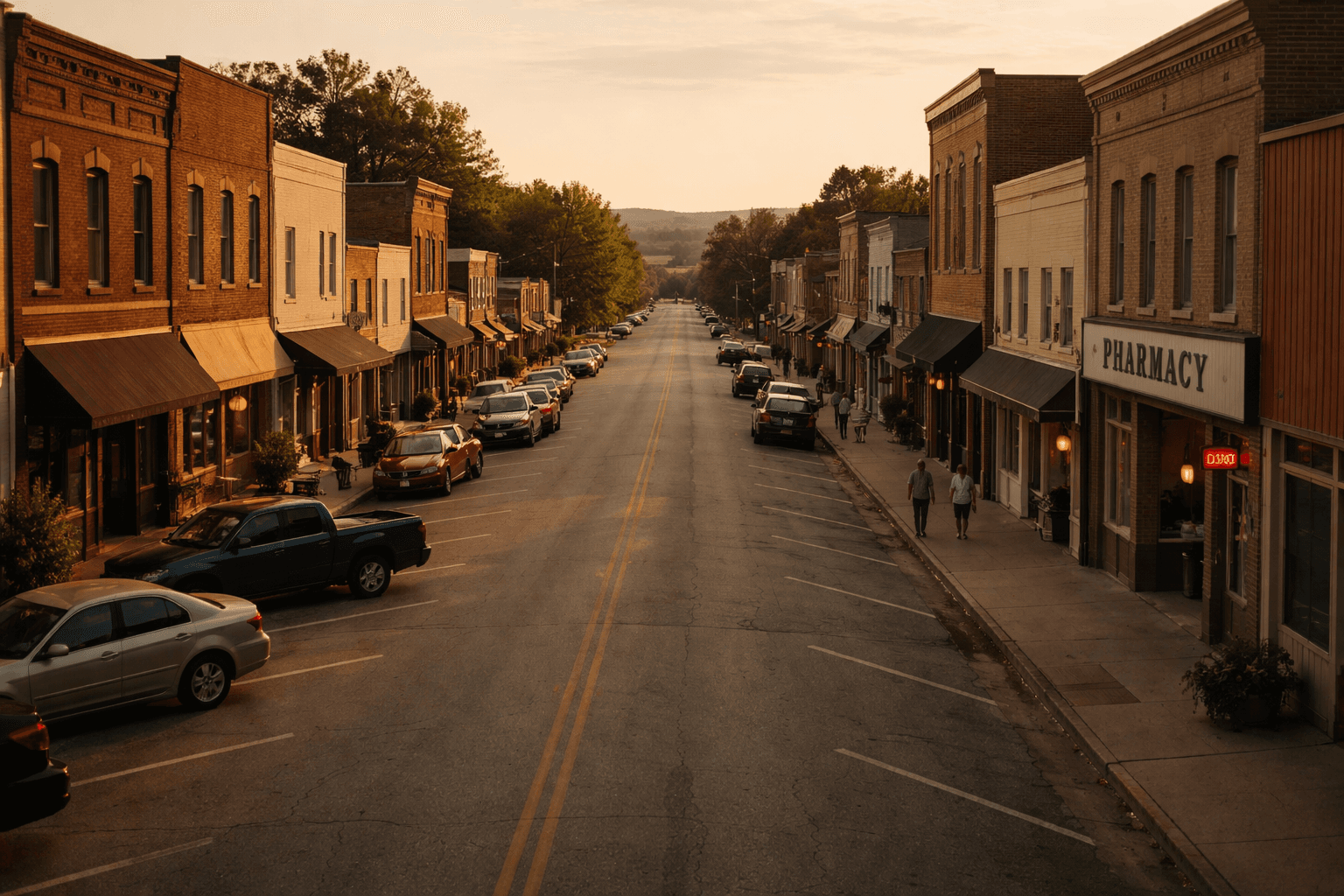

A decade of turnover hiding in plain sight
The conventional narrative about small-town retail is that it's dying, that Amazon and big-box chains hollowed out the storefronts that held rural downtowns together and that what's left is dollar stores and empty parking lots.
The data tells a more complicated story. I pulled Census Bureau County Business Patterns and Business Dynamics Statistics data for all 3,200+ US counties from 2012 through 2023. Across all of US retail, stores declined about 2% over that period but payroll per store (the closest Census proxy for revenue) grew 64%, from $353K to $577K, which is roughly 21% growth even after adjusting for inflation (~35% cumulative CPI). Fewer stores, but the survivors are genuinely more productive.
The national numbers hide enormous regional variation. Sun Belt states are actually gaining stores (Texas +7.5%, Florida +6.6%, Utah +13.4%), all fueled by population growth. Meanwhile, the Midwest and Rust Belt are hemorrhaging them (Illinois -10.6%, Iowa -9.4%, Kansas -9.5%, Pennsylvania -8.7%). And 753 counties, nearly one in four, grew their population but still lost retail. Population growth alone doesn't save retail. Something else determines which communities keep their stores and which don't.
Minnesota is a useful lens because it has everything: a major metro (Twin Cities), mid-size cities (Rochester, Duluth, St. Cloud), and dozens of small rural towns spread across lakes country, farm country, and the Iron Range. It's also an extreme case: its 7.9% store decline is four times the national average, despite 7.6% population growth. That gap between population growth and store loss is one of the widest in the country, making Minnesota a place where the forces reshaping retail everywhere are further along and easier to see.
The net loss of more than 1,000 stores understates the actual churn. Every year, roughly 1,200 retail stores close in Minnesota and roughly 1,100 open. The question isn't just how many stores Minnesota lost but what kind of stores opened and what kind closed.
The stores that survived are generating significantly more economic activity. Total retail payroll went from $7 billion to $10.7 billion and payroll per store grew from $365K to $604K, a 66% nominal increase (roughly 23% after adjusting for inflation). Some of that growth could reflect post-COVID wage pressure, where small towns competing for workers had to pay more to stay staffed. But Minnesota Department of Revenue sales tax data rules that out. Statewide retail gross sales went from $82.2 billion to $124.7 billion while the number of retail tax filers dropped from 37,500 to 35,100. Gross sales per business grew 62%, roughly 22% after inflation, almost identical to the 23% real payroll increase. Two different government datasets, two different measures, same conclusion: the surviving stores are genuinely selling more, not just paying more.
The county-level tax data shows how differently this plays out on the ground. In Kandiyohi County (Willmar), retail gross sales nearly doubled despite losing 15% of its businesses, with sales per business more than doubling to $4.1 million. In Otter Tail County (Perham), the picture is steadier: just 4.5% fewer businesses with total sales up 20%. Then there is Traverse County, a cautionary tale: sales stayed essentially flat while 46% of businesses disappeared. The per-business number looks great on paper, up 79%, but that is just arithmetic. Same revenue, half the stores.
Fewer stores, bigger stores
The trend is steady and consistent. Store count has declined every year since 2012. But payroll per store has grown every single year, even through COVID. The stores that closed were disproportionately smaller and lower-revenue. The ones that remain are larger, better staffed, and generating more economic activity per location.
“Bigger” doesn't necessarily mean physically larger buildings. It means more economically productive per location. Some surviving stores added services, like the pharmacy that added a clinic or the hardware store that became the go-to contractor supply. Others combined categories that used to be separate, like the coffee shop that also sells local food products, the gift store that hosts events. The common thread is that the survivors found ways to generate more revenue per square foot, usually by serving needs that can't be met online.
Independent research confirms this pattern. The University of Minnesota Extension's 87-County Retail Study, which uses state sales tax data rather than Census establishment counts, found the same thing: Rochester lost 11% of its stores but grew sales 16%. Even Eveleth, the lowest-ranked of 47 trade centers studied, lost 39% of its stores while growing sales 27%. Across all 47 trade centers examined, 70% were growing or thriving. Fewer stores, more sales. The survivor premium shows up in every dataset that measures it.
The study also quantifies a real headwind: online leakage. Non-Minnesota retailer sales grew 63% over the study period, reaching roughly $3 billion. One in ten Minnesota retail dollars now leaves the state entirely. This makes the experiential retail argument even more urgent because you can lose a commodity purchase to Amazon but you can't lose a brewery taproom visit or a toy store experience to an app.
The bottom line: fewer stores doesn't mean less retail. It means different retail. The stores that remain are larger, more productive, and serving different needs than the ones they replaced. The question is whether your community is on the winning side of that shift.
One category is growing. It's not who you'd hope.
Out of 12 retail subsectors in Minnesota, only two grew in store count over the last decade. General merchandise grew 15.9%. Nonstore retailers (e-commerce, direct selling) grew 6.1%. Everything else shrank. But the general merchandise number is misleading until you break it apart.
Minnesota added 112 net general merchandise stores. The growth is almost entirely dollar stores and warehouse clubs replacing department stores, which declined by 150 locations. The “growth” in general merchandise is a format swap, not new retail. Nationally, the same pattern is even starker: 13,609 net new dollar stores opened while 5,762 department stores closed.
The scale of decline in some categories is striking. Electronics and appliance stores were nearly wiped out, dropping 70.8% from 908 to 265 stores statewide. That tracks with the national pattern: across the US, electronics stores fell 64%, and 1,406 counties that had at least one electronics store in 2012 now have zero. Clothing stores fell 18.6%. Furniture dropped 17.4%. Pharmacies declined 15.5%, from 1,401 to 1,184 locations. Nationally, 795 counties lost every pharmacy they had.
The dollar store expansion is relentless. Between 2000 and 2019, the number of dollar stores in the US doubled from roughly 17,000 to more than 34,000. Dollar General alone operates over 20,000 stores and is planning 450 more in 2026, with an emphasis on rural markets. About 80% of their stores serve towns with populations under 20,000. In 18 Minnesota counties, there are now more dollar stores than grocery stores.
The dollar store displacement problem
Dollar stores are filling the gaps left by departing retailers. But what they're filling those gaps with is a problem, and the research on this is clear.
A 2024 study from the USDA Economic Research Service, North Dakota State University, and the University of Connecticut examined how dollar store entry affected independent grocery stores across the country from 2000 to 2019. The findings are stark, especially for rural areas:
The problem goes beyond grocery displacement. A peer-reviewed audit of 25 dollar stores published in the American Journal of Public Health found that only 8% stocked fresh produce. The average store dedicated 578 feet of shelf space to salty and sweet snacks and sugar-sweetened beverages, compared to a median of 4 feet for fresh fruits and vegetables. That's a 145-to-1 ratio of processed food to fresh produce.
“The likelihood of an independent grocery store closing was 5 percent in rural areas after dollar store entry, nearly three times greater than in urban areas. These effects continued in rural areas long after entry, whereas they waned in urban areas after about 5 years.”
Peer-reviewed research published in Current Developments in Nutritionconfirms the downstream impact. When dollar stores enter a market, fresh produce purchasing declines by 4% to 7.4% depending on the community, with a steeper drop for low-income households. This isn't about consumer choice but about proximity options. When the nearest grocery store to your house has 4 feet of produce area but 578 feet of chips area, your brain is being programmed to lean towards the abundant and cheaper option.
This data supports the same trend for Minnesota as well. General merchandise stores (the category that includes dollar stores) grew 32.3% in rural counties, more than five times the metro growth rate of 5.9% but at the same time, rural pharmacies dropped 7.3% and rural food and beverage stores grew only 3%. The dollar stores are not just arriving but they are displacing.
This is the displacement problem in one sentence: communities are trading pharmacies, grocery stores, and clothing shops for dollar stores that stock 578 feet of chips and 4 feet of produce.
The counties that are bucking the trend
Not every rural county in Minnesota is losing retail. Out of 72 truly rural counties (excluding the Twin Cities metro, outer suburbs, and regional cities), a significant number are actually gaining stores. The question is why.
| # | County | Stores | Store Chg | Payroll Chg | $/Store |
|---|---|---|---|---|---|
| 1 | Traverse | 23 → 27 | +17.4% | +59.1% | $183K |
| 2 | Lake | 44 → 51 | +15.9% | +48.5% | $292K |
| 3 | Dodge | 49 → 53 | +8.2% | +95.9% | $261K |
| 4 | Mille Lacs | 98 → 106 | +8.2% | +103.8% | $391K |
| 5 | Nicollet | 76 → 81 | +6.6% | +114.9% | $672K |
| 6 | Clearwater | 34 → 36 | +5.9% | +62.1% | $188K |
| 7 | Hubbard | 105 → 111 | +5.7% | +76.1% | $311K |
| 8 | Cass | 133 → 137 | +3.0% | +76.2% | $258K |
| 9 | Crow Wing | 366 → 370 | +1.1% | +84.0% | $516K |
| 10 | Pope | 41 → 41 | 0.0% | +98.9% | $385K |
| 17 | Otter TailPerham | 261 → 252 | -3.4% | +38.3% | $361K |
The top performers share some common traits. Traverse, Lake, and Hubbard counties are all in Minnesota's lakes region, where tourism drives seasonal retail demand. Mille Lacs has a significant tribal economy and casino-driven traffic. Nicollet County includes Mankato, a growing regional center. Crow Wing County (Brainerd Lakes area) held nearly flat on stores while growing payroll 84%.
Otter Tail County, home to the lakes country town of Perham, ranks #17 out of 72 rural counties for store retention. It lost only 3.4% of its stores compared to the rural average of 9.6%. What makes Otter Tail interesting isn't the overall number. It's what's growing there. Food and beverage stores surged 36% (from 28 to 38 locations). Pharmacies grew 27% (from 11 to 14). Clothing held steady. In a state where pharmacies are declining 15.5% and food retail is basically flat, Otter Tail is growing in exactly the categories that make a community livable.
The contrast with the bottom of the list is telling. Kandiyohi County (Willmar area) lost 25.8% of its stores. Rock County lost 38.1%. Lincoln County lost 23.7% and saw payroll growth of only 8.3%, the weakest survivor premium in the state. The counties that declined the most are also the ones where the remaining stores aren't growing much either. When a community loses retail mass, the survivors don't necessarily thrive. There's a tipping point.
The Perham model: an ecosystem, not a store
The counties that are gaining retail aren't competing with dollar stores on price. They're competing on categories dollar stores can't serve: fresh food, pharmacy, experiences, the things you can't order on Amazon. One town shows what that looks like in practice.
To understand what winning looks like in practice, look at Perham, Minnesota. Population 3,601. Otter Tail County. About three hours northwest of Minneapolis, in the heart of lakes country.
Goose Group Inc. has built something in Perham that the data says shouldn't work. The company operates Wild Goose (a kitchen store), Goose Gang (a toy store where kids can spend an entire afternoon exploring), Nest (a coffee shop partnered with a gift and lifestyle store under one roof), Disgruntled Brewing (a brewery and taproom that doubles as a community gathering space), and B's Chocolates (handcrafted in Willmar, sold across all Goose Group stores). They also run Lucky Duck (a second toy store) and Happy Sol (clothing and gifts) in New London, just two hours south in another popular lakes area. It's a portfolio that spans specialty retail, food and beverage, entertainment, and destination shopping — and Goose Group is one part of a broader retail community in Perham that gives visitors multiple reasons to spend a few hours or a weekend.
The key insight isn't any one of these businesses. It's that they're an ecosystem. Nest combines coffee and lifestyle retail so a morning latte turns into browsing. The toy store creates a destination that families drive 45 minutes to visit — and while they're in town, they browse the gift shops, grab a beer at Disgruntled, and pick up B's chocolates. The brewery creates a community gathering space that gives locals a reason to come to town on a Tuesday night. Each business reinforces the others. No single store would justify the trip. Together, they create a reason to show up.
In retail economics, this is called a “pull factor,” a concept the University of Minnesota Extension uses to measure whether a community draws shoppers from beyond its borders. A pull factor above 1.0 means a town is a net importer of retail spending. Communities with strong experiential retail anchors tend to have high pull factors because they give people from surrounding areas a reason to drive in and spend. The Goose Group ecosystem in Perham is a textbook pull factor generator: every brewery visit, every toy store trip, every gift shop browse brings spending from outside the community into the community.
Perham isn't competing on price. It isn't competing on convenience. Dollar General can sell canned goods cheaper and Amazon can deliver a package faster. Perham is competing on reasons to show up, and the data shows it's working. A family doesn't drive 30 minutes to buy a can of beans. They drive 30 minutes for a toy store their kids love, a brewery with a taproom, a gift shop that feels like an experience. And while they're there, they buy groceries, fill prescriptions, browse home decor. The destination traffic lifts the entire retail ecosystem.
Where this is heading
The reorganization of small-town retail isn't slowing down. Dollar General is planning 450 new stores in 2026. Amazon is investing $4 billion in rural delivery expansion, pushing same-day and next-day service into 4,000+ small towns. The competitive pressure on independent retailers is only going to increase.
COVID accelerated what was already happening. Before the pandemic, Minnesota was losing about 144 retail stores per year. During 2019 to 2021, that rate nearly doubled to 243 stores per year. But post-COVID (2021 to 2023), the loss rate collapsed to just 17 stores per year, near-stabilization. After 13 consecutive years where more stores closed than opened (2008–2021), Minnesota's retail sector finally turned positive in 2022 and 2023. Whether this holds depends on what kind of stores are opening.
The Perham model points to where this could go. Large retailers are already experimenting with smaller formats to reach markets that can't support a full-size store. Target has been opening small-format locations in college towns and dense urban neighborhoods. The same logic applies to rural and small-town markets, and not just for general merchandise. A brand like Starbucks could reach small-town customers through a licensed partnership with a local coffee shop that already has the foot traffic, rather than building a standalone store that doesn't pencil out. Operators like Goose Group have already built the foot traffic and the destination pull. A national retailer looking to reach these customers doesn't need to build from scratch. They need a local partner who already has the community showing up.
That's where the assortment question becomes critical. For multi-location retailers, which stores should carry which categories? In communities where delivery infrastructure is limited and the nearest alternative is a 30-minute drive, getting the product mix right isn't just a merchandising decision, it's an access decision that affects whether the community can sustain itself. The same analytical framework that determines which SKUs go in which warehouse also determines which products belong in which store. Map demand. Understand what the local customer needs. Position the right inventory as close to them as possible.
The infrastructure is there. The demand is there. Rural median household income is roughly 15% higher than the national average when adjusted for cost of living. What's missing is the connection between national supply chains and local retail ecosystems: through partnerships, through the right assortment, through formats designed for the market rather than copied from the suburb. The retailers and communities that figure this out will be the ones that thrive. The ones waiting for the old model to come back won't.
Small-town retail isn't dying. It's being reorganized. The data, across all 3,200+ US counties, shows exactly who's winning, who's losing, and what the survivors are doing differently. The stores that can't be replaced by Amazon are thriving. The ones that can are disappearing. And the communities that recognize this and invest accordingly will be the ones where the stores, the jobs, and the community stay.

About the author
I've spent my career in inventory placement and supply chain strategy at Amazon, Walmart, Target, American Eagle Outfitters, and Spreetail, building the models and processes that determine which products go where. At Target, I created an inventory health process from scratch that identified over $1B in unproductive inventory across distribution centers, fulfillment centers, and 1,000+ stores, and built the cross-functional processes to fix it.
If you're a retailer trying to figure out the right assortment for your stores, or a community leader working on retail development strategy, I'd be happy to talk through it. I offer a free 30-minute consultation to assess your situation and identify the highest-impact opportunities.
Book a Free Consultation →This analysis uses County Business Patterns (CBP) and Business Dynamics Statistics (BDS) data from the U.S. Census Bureau, accessed via the Census API. CBP provides annual data on business establishments, employment, and payroll by county and industry (NAICS codes) for all 3,200+ US counties. BDS provides establishment births (openings) and deaths (closings) at the state level for all 50 states. Census decennial population data (2010, 2020) provides the demographic baseline. Primary analysis covers 2012 through 2023. Independent validation from the University of Minnesota Extension 87-County Retail Study, which uses state sales tax data rather than Census establishment counts. Retail is defined as NAICS sector 44-45. Subsectors use 3-digit NAICS codes. Metro counties are defined as the 7-county Twin Cities metro plus Olmsted (Rochester), St. Louis (Duluth), and Stearns (St. Cloud). All other counties are classified as rural. Dollar store displacement statistics are from the USDA Economic Research Service (2024) and peer-reviewed studies published in the American Journal of Public Health and Current Developments in Nutrition. All payroll figures are in nominal dollars unless otherwise noted. Cumulative CPI inflation from 2012 to 2023 was approximately 35%. Store counts and employment figures are real counts not affected by inflation.