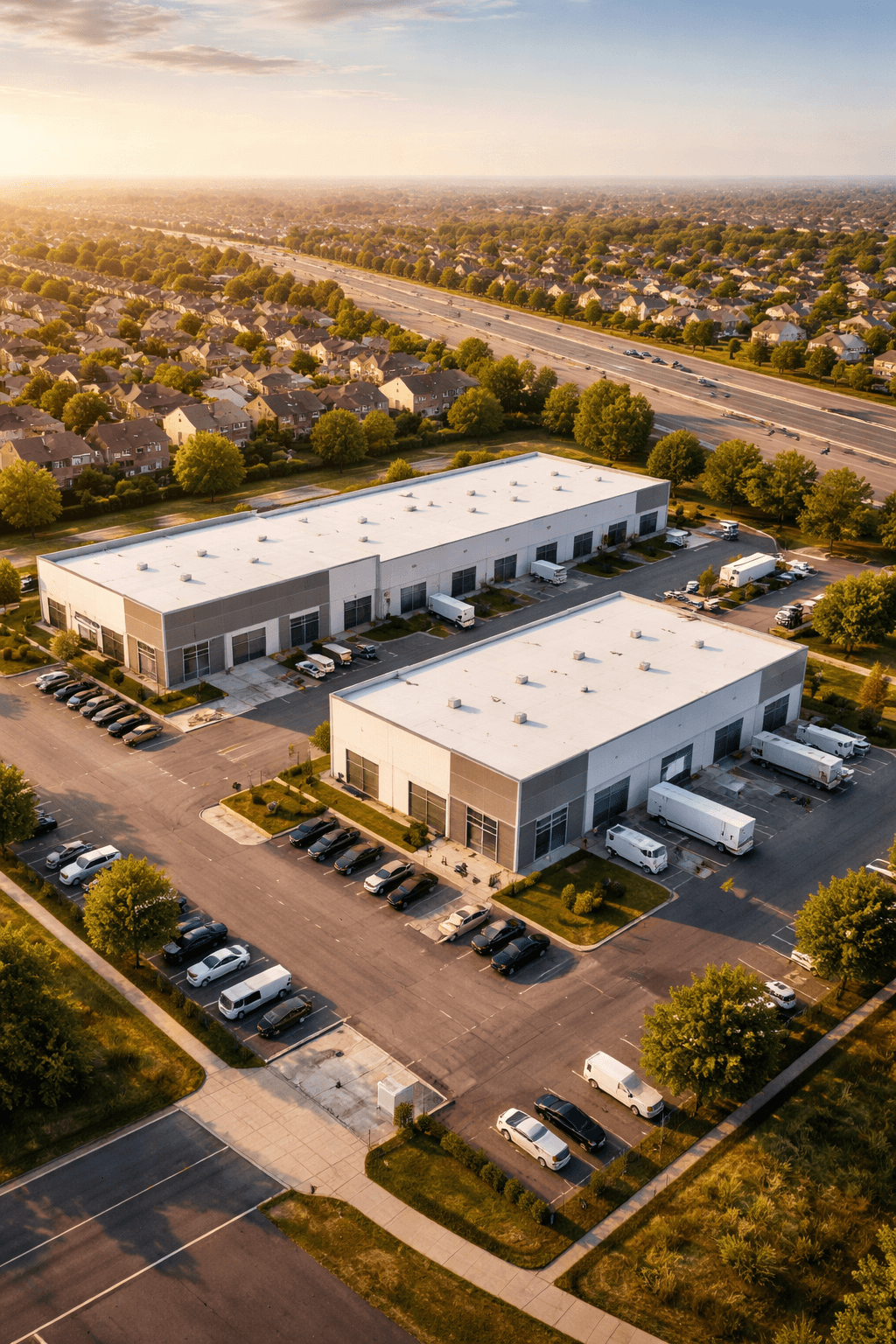

Warehouses are shrinking. Here's the data behind the shift.
There's been a lot of talk about companies moving away from massive centralized distribution centers toward smaller, closer facilities. Having spent my career in inventory placement across several of America's largest retailers, I wanted to see if the data actually backed it up.
This analysis covers 1,816 warehouse building permits across eight US states, pulled from public permit databases. The dataset spans new construction permits from 2020 through early 2025 for facilities 10,000 square feet and above, classified under warehouse and storage use groups. These eight states were selected because they cover the country's major logistics corridors: the Northeast (New Jersey), West Coast (California), Midwest (Illinois, Ohio), South (Texas, Louisiana, Georgia), and Southwest (Arizona). The goal was to look at what's actually getting permitted and built, not what's being marketed.
2021 was the high-water mark for mega-warehouse construction in this dataset. Developers filed 24 permits for 500,000+ sqft facilities that year across these eight states, making up 8% of all new warehouse permits. By 2025, that number had dropped to just 6. That's 2% of the total.
Meanwhile, small warehouses (under 50,000 sqft) climbed from 46% to 58% of all new permits. The industry isn't building less. It's building smaller. And the geographic data shows why.
Smaller every year
Look at the orange band in the chart above. That's mega-warehouses. It's essentially gone after 2022. The dark green band (small facilities) is widening every year, and 2025 is the most dramatic shift in the entire dataset.
The average new warehouse hit 168,000 sqft in 2021 and has fallen 46% to 91,000 sqft in 2025. The median dropped from 62,000 to 40,000 sqft over the same period. What stands out is that the gap between average and median is narrowing. There are fewer massive outliers pulling the average up. The entire size distribution is compressing downward.
Closer to the customer
The size shift raises an obvious question: where are these smaller facilities going up? Breaking the data down by location type (metro cores versus suburban areas), the pattern becomes clear immediately.
Small warehouses in metro cores grew 21% between the two periods. Suburban locations barely moved. The growth is happening exactly where you'd expect if companies are optimizing for last-mile delivery: where population density is highest, where the last mile is shortest, and where delivery promises are hardest to keep.
A few specific examples stand out. Chicago's suburbs nearly doubled their small warehouse count, from 7 to 13 permits, with Elk Grove Village emerging as a micro-fulfillment hub. The NJ Turnpike Corridor, which has been the home of massive DCs serving the Northeast for decades, saw its large warehouse permits drop from 32 to 17. But small node permits in that same corridor grew from 34 to 49. The corridor is still active, but the type of facility being built there has shifted significantly toward smaller formats.
| # | Market | Permits | Avg Size | Trend |
|---|---|---|---|---|
| 1 | MesaAZ | 96 | 26K | Growing |
| 2 | Los AngelesCA | 27 | 22K | Slowing |
| 3 | San FranciscoCA | 24 | 24K | Growing |
| 4 | CincinnatiOH | 8 | 22K | Growing |
| 5 | AustinTX | 6 | 25K | Slowing |
| 6 | Baton RougeLA | 6 | 21K | Slowing |
| 7 | Egg Harbor TwpNJ | 6 | 17K | Emerging |
| 8 | Tinton FallsNJ | 5 | 28K | Growing |
Mesa, Arizona dominates with 96 small warehouse permits in two years, driven by the Phoenix metro's explosive population growth and its strategic position as a Southwest distribution hub. Los Angeles and San Francisco follow, both markets where proximity to the end consumer comes at a premium and getting a package there fast requires being close.
Why proximity pays
Network decisions ultimately come down to cost and revenue impact. The reason companies are making this shift isn't because of a trend piece or a conference keynote. It's because the economics of last-mile delivery have made it unavoidable.
Last-mile delivery now accounts for 53% of total shipping cost, up from 41% in 2018. The single biggest lever you have to reduce that cost is distance. A package traveling 15 miles from a small node near the customer costs a fraction of what it costs to ship from a mega-DC 200 miles away. And the delivery promise is completely different. 15 miles can be same-day. 200 miles is two-day at best.
The revenue impact is significant. Roadie's research shows that 80% of companies that implemented same-day delivery saw revenue increases, with nearly two-thirds reporting gains of 6% or more. Testing consistently shows a 10 to 14% conversion uplift when a fast delivery window appears prominently at checkout, averaging 12% in the US.
“48% of shopping carts are abandoned due to extra costs like shipping, fees, and taxes added during final checkout. Fast shipping options alone reduce abandonment by 17%.”
And then there's the flip side. Slow delivery is expensive in ways that don't show up in your shipping line. When a competitor offers next-day and you offer five-day, you don't just lose that order. You lose the customer. The companies that figured out proximity early consistently took share from the ones that didn't.
When you model this out, the math consistently points to the same conclusion: the cost of maintaining one massive centralized DC is increasingly higher than the cost of distributing inventory across multiple smaller, closer nodes. The savings in last-mile cost, the uplift in conversion, and the reduction in cart abandonment all compound.
The end of the mega-DC model
For two decades, the dominant logistics strategy was consolidation. Build fewer, bigger warehouses. Centralize inventory. Ship everywhere from a handful of massive hubs. It made sense when the standard delivery promise was 5 to 7 business days and customers were tolerant of wait times.
That world is gone. Amazon set the bar with Prime two-day, then raised it to next-day, and is now pushing sub-same-day in major metros. Walmart, Target, and every mid-market retailer is chasing the same standard. Consumers have been retrained. If it's not arriving tomorrow, they'll buy from someone who can make that promise.
The problem with a mega-DC model in a next-day world comes down to geometry. A single 1,000,000 sqft warehouse in central New Jersey can reach the entire Northeast corridor, but it can't deliver to Manhattan by tomorrow afternoon. Four 50,000 sqft facilities in North Jersey, Brooklyn, Long Island, and Connecticut can. Same total square footage, distributed differently, fundamentally different delivery promise.
That's exactly what the permit data is showing. Companies aren't reducing their total warehouse footprint. They're redistributing it. More locations, smaller per location, closer to where orders originate.
Three questions for your network
If you're running a distribution network today, the permit data suggests three questions worth asking. These are the same analyses that drive network design decisions at companies like Amazon, Walmart, and Target, and the frameworks scale down. A mid-market retailer or e-commerce brand can run them with a fraction of the complexity.
The difference for a mid-market company is scale. Amazon has hundreds of nodes. You might only need two or three additional locations to dramatically improve your delivery promise and bring your per-order cost down. The hard part isn't the real estate. It's knowing which SKUs go where, how much safety stock to carry at each location, and how to manage inventory health across a more distributed network without letting unproductive inventory pile up. That's the part I have spent most of my time on throughout my career.
This isn't just an e-commerce problem
Everything above applies to e-commerce fulfillment, but the same principles hold for brick-and-mortar retail. For retailers in smaller markets where same-day delivery isn't realistic and even two-day is a stretch, the question shifts from “where should I put a warehouse?” to “which stores should carry which SKUs?”
Across the Midwest and rural America, there are thousands of retailers running $5M to $20M businesses where the answer to faster fulfillment isn't another warehouse. It's smarter assortment in the stores that already exist. Figuring out the right product mix for a store in rural Minnesota is the same inventory placement problem as deciding which SKUs to forward-position in a 30,000 sqft node outside Phoenix. The data is different, but the framework is the same.
Where logistics is heading
The era of the mega-warehouse isn't over, but its dominance is fading. The permit data across eight states and 1,816 projects makes it hard to argue otherwise. The industry is building smaller, building closer, and building faster.
The companies that are ahead of this aren't the ones with the biggest warehouses. They're the ones who figured out the right inventory, in the right quantity, in the right location, closest to the customer who's going to order it. That's what inventory placement is. And based on what the data is showing, it's becoming the most consequential decision in logistics.

About the author
I've spent most of my career solving exactly this problem: where to put inventory, what to stock there, and how to make the delivery promise math work. At Amazon, Walmart, Target, American Eagle Outfitters, and Spreetail, I built and optimized the network models and processes that decide which warehouse gets which SKU, how much safety stock to carry at each node, and what delivery promise you can make to each zip code. At Target, I created an inventory health process from scratch that identified over $1B in unproductive inventory across DCs, FCs, and 1,000+ stores and built the cross-functional processes to fix it.
If you're rethinking your distribution footprint, evaluating where to open your next facility, or trying to figure out which SKUs to forward-position for faster delivery, I'd be happy to talk through it. I offer a free 30-minute consultation to assess your current network and identify the highest-impact opportunities.
Book a Free Consultation →All 1,816 permits are available on Warehouse Permit Watch, an interactive map and database covering warehouse construction across 8 states. Filter by size, date, location, and more.
Open Warehouse Permit Watch →This analysis is based on 1,816 warehouse building permits pulled from public permit databases across eight US states (AZ, CA, GA, IL, LA, NJ, OH, TX). The dataset covers new construction permits from January 2020 through April 2025 for facilities 10,000+ sqft classified under warehouse and storage use groups (S-1, S-2, F-1, F-2). 2025 data is partial (January through early April). Permits represent filed projects, not completed construction. Some may be amended or cancelled. The eight-state sample covers major US logistics corridors but may not represent national trends.